




Submitted manuscript
[4] Miichi S, Shimamura D, Yasuda J, Tokutsu R, Yamano T*
A CO2-limitation-induced cytosolic repressor enables shutdown of the algal CO2-concentrating mechanism.
 We discovered that the cytosolic factor HCR1 is a second repressor that shuts down the algal CO2-concentrating mechanism. This study follows Shimamura et al., PNAS 2026.
[3] Matsuo K and Yamano T*
Unsupervised machine-learning identifies latent pyrenoid states linked to mitotic remodeling defects and CO2-dependent growth.
We combined machine learning with live imaging to study links between subtle shape abnormalities in a phase-separated organelle, its remodeling during cell division, and CO2-dependent growth.
[2] (Collaboration) Shin S, Choi BY, Song J, Je S, Roh Y, Kim E, Yamano T, Li-Beisson Y, Shim D, Yamaoka Y* [1] (Collaboration) Kanazawa H, Takusagawa M, Shimamura D, Kinoshita Y, Nishiyama T, Tokutsu R, Onishi M, Shikanai T, Yamano T, Nishimura Y*
Medium acidification and redox imbalance drive triacylglycerol hyperaccumulation in Chlorella sorokiniana.
MITH1 promotes biased positioning of chloroplast nucleoids linked to localized rbcL expression and pyrenoid biogenesis in Chlamydomonas reinhardtii.

2026
[3] (Method paper) Shimamura D and Yamano T*
Routine Isolation of Random Insertion Mutants in Cell-Walled Chlamydomonas reinhardtii by Electroporation of an AphVII Hygromycin-Resistance Cassette.
Methods Mol Biol. in press
We describe how to transform green algae with intact cell walls using square-wave pulse electroporation.
[2]  (Review paper) Shimamura D and Yamano T*
Regulatory Logic of the Chlamydomonas CO2-Concentrating Mechanism: Coupling Carbon Flux, Energy Supply, and Pyrenoid Architecture.
Front Plant Sci. 2026 July 8;17:1882169.


 We reviewed the CO2-concentrating mechanism in the green alga Chlamydomonas, bringing together carbon flow, energy supply, pyrenoid structure, and regulatory networks.
[1] Shimamura D, Yasuda J, Yamahara Y, Nakano H, Ozawa S, Tokutsu R, Yamagami A, Matsushita T, Takahashi Y, Nakano T, Fukuzawa H, Yamano T*
A nuclear CobW/WW-domain factor represses the CO2-concentrating mechanism in the green alga Chlamydomonas reinhardtii.
Proc Natl Acad Sci USA.2026 Feb 10;123(6):e2518136123.

 We discovered CBP1, a nuclear repressor that helps cells save energy by controlling the CO2-concentrating mechanism in aquatic photosynthesis.
2025
[4] (Opinion) Japan can be a science heavyweight once more — if it rethinks funding
Nature 2025 Feb;638(8050):318-320.
An opinion article co-signed by 138 Japanese researchers that identifies problems in Japan's science and technology policy and proposes solutions.
[3] (Review paper) Yamano T*
Algal Pyrenoids in Global Carbon Cycling: Frontier Research on Structure, Function, and Convergent Evolution
Algal Science and Technology 18(1):13-25
We reviewed the molecular basis and evolutionary significance of the pyrenoid, an algal CO2-concentrating organelle involved in about one-third of global carbon cycling.
[2] (Review paper) Yamaoka Y*, Petroutsos D, Je S, Yamano T, Li-Beisson Y
Light, CO2, and carbon storage in microalgae
Curr Opin Plant Biol. 2025 Feb 20:84:102696.
A review of how interactions between light and CO2 affect carbon metabolism in microalgae.
[1] (Review in Japanese) Shimamura D, Matsuda A, Yamano T*
Extracellular carbonic anhydrase enhances CO2 uptake in green algae
Bioscience and Industry (B&I) 2025 83(2):1320133
A commentary on Shimamura et al., Plant Physiol. 2024, which clarified the role of extracellular carbonic anhydrase.
2024
[3] Shimamura D, Ikeuchi T, Matsuda A, Tsuji Y, Fukuzawa H, K Mochida, Yamano T*
Periplasmic carbonic anhydrase CAH1 contributes to high inorganic carbon affinity in Chlamydomonas reinhardtii
Plant Physiol. 2024 Dec 2;196(4):2395-2404.
We clarified the role of carbonic anhydrase CAH1 in the CO2-concentrating mechanism, resolving a debate that had lasted for 40 years.
[2] (Review in Japanese) Matsuo K, Yamano T*
The molecular basis of a CO2-concentrating organelle involved in the function and regulation of aquatic photosynthesis
Agri-Bio, July 2024 Special Issue
[1] (Review in Japanese) Yamano T*
Pyrenoids and the CO2-concentrating mechanism in green algae
In "Current Status and Future Prospects of Microalgal Bioproduction", Agri-Bio, February 2024 Issue
2023
[5] (Review in Japanese) Yamano T* [3] (Review in Japanese) Yamano T* [2] (Review in Japanese) Yamano T*, Hirakawa Y, Matsuzaki R [1] Shimamura D, Yamano T*, Niikawa Y, Donghui H, Fukuzawa H
The CO2-concentrating mechanism in cyanobacteria
In "Technologies for CO2 Utilization by Autotrophic Bacteria", Part II, Chapter 18, pp.227-232. CMC Publishing, published December 13, 2023
 [4] (Collaboration) Yoshizawa S*, Azuma T, Kojima K, Inomura K, Hasegawa M, Nishimura Y, Kikuchi M, Armin G, Tsukamoto Y, Miyashita H, Ifuku K, Yamano T, Marchetti A, Fukuzawa H, Sudo Y, Kamikawa R
Light-driven proton pumps as a potential regulator for carbon fixation in marine diatoms
Microbes Environ. 2023;38(2):ME23015.
In collaboration with the Yoshizawa lab at the University of Tokyo, we proposed a theoretical model in which local acidic pools generated by light-driven H+ transport through microbial rhodopsins promote CO2 fixation. This paper received the 2023 M&E Paper Award.
Understanding the green algal pyrenoid as a phase-separated CO2-concentrating organelle
Plant Morphology 35: 3-8 (2023)
A review of the molecular mechanisms of the CCM, focusing on the model green alga Chlamydomonas.
Pyrenoids: The Cutting Edge of Plant Phase-Separated Organelles
Plant Morphology 35: 1-2 (2023)
An overview of the symposium "Pyrenoids: The Cutting Edge of Plant Phase-Separated Organelles" at the 86th Annual Meeting of the Botanical Society of Japan.
A pyrenoid-localized protein SAGA1 is necessary for Ca2+-binding protein CAS-dependent expression of nuclear genes encoding inorganic carbon transporters in Chlamydomonas reinhardtii
Photosynth Res. 2023 May;156(2):181-192.
Based on analyses of pyrenoid-deficient mutants, we proposed that the pyrenoid is one source of retrograde signals from the chloroplast to the nucleus.
2022
[5] (Collaboration) Gururaj M, Ohmura A, Ozawa M, Yamano T, Fukuzawa H, Matsuo T*
A potential EARLY FLOWERING 3 homolog in Chlamydomonas is involved in the red/violet and blue light signaling pathways for the degradation of RHYTHM OF CHLOROPLAST 15
PLoS Genet. 2022 Oct 17;18(10):e1010449.
[4] Tsuji Y*, Kinoshita A, Tsukahara M, Ishikawa T, Shinkawa H, Yamano T, Fukuzawa H*
A YAK1-type protein kinase, triacylglycerol accumulation regulator 1, in the green alga Chlamydomonas reinhardtii is a potential regulator of cell division and differentiation into gametes during photoautotrophic nitrogen deficiency
J Gen Appl Microbiol. 2023 Jun 22;69(1):1-10.
We showed that the well-known role of DYRK in promoting differentiation through cell division control is conserved in green algae under photoautotrophic, nitrogen-deficient conditions.
[2] (Collaboration) Choi BY, Kim H, Shim D, Jang S, Yamaoka Y, Shin S, Yamano T, Kajikawa M, Jin E, Fukuzawa H*, Lee Y* [3] (Collaboration) Mei NL, Komaki S, Takahashi H, Yamano T, Fukuzawa H, Hashimoto T*
Hyperosmotic stress-induced microtubule disassembly in Chlamydomonas reinhardtii
BMC Plant Biol. 2022 Jan 22;22(1):46.
The Chlamydomonas bZIP transcription factor BLZ8 confers oxidative stress tolerance by inducing the carbon-concentrating mechanism
Plant Cell 2022 Feb 3;34(2):910-926.
We showed that a bZIP transcription factor provides resistance to oxidative stress by regulating the expression of inorganic carbon transporters and carbonic anhydrases involved in the CCM.
[1] Yamano T*, Toyokawa C, Shimamura D, Matsuoka T, Fukuzawa H
CO2-dependent migration and relocation of LCIB, a pyrenoid-peripheral protein in Chlamydomonas reinhardtii
Plant Physiol. 2022 Feb 4;188(2):1081-1094.
We revealed how changes in chloroplast protein localization help maintain aquatic photosynthesis under changing conditions. This work was featured in Nikkei Sangyo Shimbun.
2021
[1] Tsuji Y, Kusi-Appiah G, Kozai N, Fukuda Y, Yamano T, Fukuzawa H*
Characterization of a CO2-Concentrating Mechanism with Low Sodium Dependency in the Centric Diatom Chaetoceros gracilis.
Mar Biotechnol (NY). 2021 Jun;23(3):456-462.
We showed that the CCM of the commercially useful diatom Chaetoceros gracilis has a low dependence on sodium and can function even in a medium without sodium salts.
2020
[6] (Collaboration) Kato-Minoura T*, Ogiwara Y, Yamano T, Fukuzawa H, Kamiya RChlamydomonas reinhardtii tubulin-gene disruptants for efficient isolation of strains bearing tubulin mutations.
PLoS One. 2020 Nov 23;15(11):e0242694.
[5] (Review in Japanese) Yamano T
Pyrenoids: CO2-concentrating structures in photosynthesis
In The Full Picture of Phase Separation Biology, edited by Shiraki K. Tokyo Kagaku Dojin
[4] (Collaboration) Nitta N, Iino T, Isozaki A, Yamagishi M, Kitahama Y, Sakuma S, Suzuki Y, Tezuka H, Oikawa M, Arai F, Asai T, Deng D, Fukuzawa H, Hase M, Hasunuma T, Hayakawa T, Hiraki K, Hiramatsu K, Hoshino Y, Inaba M, Inoue Y, Ito T, Kajikawa M, Karakawa H, Kasai Y, Kato Y, Kobayashi H, Lei C, Matsusaka S, Mikami H, Nakagawa A, Numata K, Ota T, Sekiya T, Shiba K, Shirasaki Y, Suzuki N, Tanaka S, Ueno S, Watarai H, Yamano T, Yazawa M, Yonamine Y, Di Carlo D, Hosokawa Y, Uemura S, Sugimura T, Ozeki Y, Goda K*
Raman image-activated cell sorting
Nat Commun. 2020 Jul 10;11(1):3452.
[3] Toyokawa C, Yamano T, Fukuzawa H*
Pyrenoid Starch Sheath Is Required for LCIB Localization and the CO2-Concentrating Mechanism in Green Algae.
Plant Physiol. 2020 Apr;182(4):1883-1893.
We established the importance of the starch sheath surrounding the pyrenoid for the CCM.
[2] Yamano T, Fukuzawa H*
Transformation of the Model Microalga Chlamydomonas reinhardtii Without Cell-Wall Removal.
Methods Mol Biol. 2020;2050:155-161.
[1] (Collaboration) Jang S, Kong F, Lee J, Choi BY, Wang P, Gao P, Yamano T, Fukuzawa H, Kang BH, Lee Y*
CrABCA2 Facilitates Triacylglycerol Accumulation in Chlamydomonas reinhardtii under Nitrogen Starvation.
Mol Cells. 2020 Jan 31;43(1):48-57.
2019
[6] (Collaboration) Hidayati NA, Yamada-Oshima Y, Iwai M, Yamano T, Kajikawa M, Sakurai N, Suda K, Sesoko K, Hori K, Obayashi T, Shimojima M, Fukuzawa H, Ohta H*LIPID REMODELING REGULATOR 1 (LRL1) Is Differently Involved in the Phosphorus-depletion Response from PSR1 in Chlamydomonas reinhardtii.
Plant J. 2019 Nov;100(3):610-626.
We identified an algal regulator that controls lipid accumulation during nutrient deficiency.
[5] (Collaboration) Isozaki A, Mikami H, Hiramatsu K, Sakuma S, Kasai Y, Iino T, Yamano T, Yasumoto A, Oguchi Y, Suzuki N, Shirasaki Y, Endo T, Ito T, Hiraki K, Yamada M, Matsusaka S, Hayakawa T, Fukuzawa H, Yatomi Y, Arai F, Di Carlo D, Nakagawa A, Hoshino Y, Hosokawa Y, Uemura S, Sugimura T, Ozeki Y, Nitta N, Goda K*
A practical guide to intelligent image-activated cell sorting.
Nature Protoc. 2019 Aug;14(8):2370-2415.
[4] (Review in Japanese) Yamano T, Fukuzawa H*
How the photosynthetic turbo engine works and is controlled in the green alga Chlamydomonas
Kougousei Kenkyu 29(1):14-28 (2019)
[3] (Collaboration) Yamaoka Y, Shin S, Choi BY, Kim H, Jang S, Kajikawa M, Yamano T, Kong F, Legeret B, Fukuzawa H, Li-Beisson Y, Lee Y*
The bZIP1 Transcription Factor Regulates Lipid Remodeling and Contributes to ER Stress Management in Chlamydomonas reinhardtii.
Plant Cell May;31(5):1127-1140.
[2] (Collaboration) Owa M, Uchihashi T, Yanagisawa H, Yamano T, Iguchi H, Fukuzawa H, Wakabayashi K, Ando T, Kikkawa M*
Inner lumen proteins stabilize doublet microtubules in cilia and flagella.
Nature Commun. 2019 Mar 8;10(1):1143. doi: 10.1038/s41467-019-09051-x.
We reported new proteins that bind to the inside of ciliary microtubules and reinforce their structure.
[1] Shinkawa H, Kajikawa M, Nomura Y, Ogura M, Sawaragi Y, Yamano T, Nakagami H, Sugiyama N, Ishihama Y, Kanesaki Y, Yoshikawa H, Fukuzawa H*
Algal Protein Kinase, Triacylglycerol Accumulation Regulator1, Modulates Cell Viability and Gametogenesis in Carbon/Nitrogen Imbalanced Conditions.
Plant Cell Physiol. 2019 Apr 1;60(4):916-930. doi: 10.1093/pcp/pcz010.
2018
[3] (Collaboration) Nitta N, Sugimura T, Isozaki A, Mikami H, Hiraki K, Sakuma S, Iino T, Arai F, Endo T, Fujiwaki Y, Fukuzawa H,Hase M,Hayakawa T, Hiramatsu K,Hoshino Y, Inaba M, Ito T, Karakawa H, Kasai Y, Koizumi K, Lee S, Lei C,Li M, Maeno T, Matsusaka S, Murakami D, Nakagawa A, Oguchi Y, Oikawa M, Ota T, Shiba K, Shintaku H, Shirasaki Y, Suga K, Suzuki Y, Suzuki N, Tanaka Y, Tezuka H, Toyokawa C, Yalikun Y, Yamada M, Yamagishi M, Yamano T, Yasumoto A, Yatomi Y, Yazawa M, Di Carlo D, Hosokawa Y, Uemura S, Ozeki Y, Goda K*Intelligent Image-Activated Cell Sorting
Cell 2018 Sep 20;175(1):266-276.e13. doi: 10.1016/j.cell.2018.08.028.
We developed an image-activated cell sorter that reduced the time needed to select rare cells by about 6,500-fold, demonstrating its potential to enable unexpected discoveries through serendipity.
[2] (Textbook) Yamano T Chapter 18, "Reading the Blueprint of the Body: Genome Information and Evolution"
In Frontiers in Life Science from Kyoto University, edited by the Graduate School of Biostudies, Kyoto University. Kodansha
[1] Yamano T, Toyokawa C, Fukuzawa H*
High-resolution suborganellar localization of Ca2+-binding protein CAS, a novel regulator of CO2-concentrating mechanism.
Protoplasma. 2018 Jul;255(4):1015-1022. doi: 10.1007/s00709-018-1208-2.
We tracked how the localization of CAS, a calcium-binding protein important for CCM induction, changes with CO2 levels.
2017
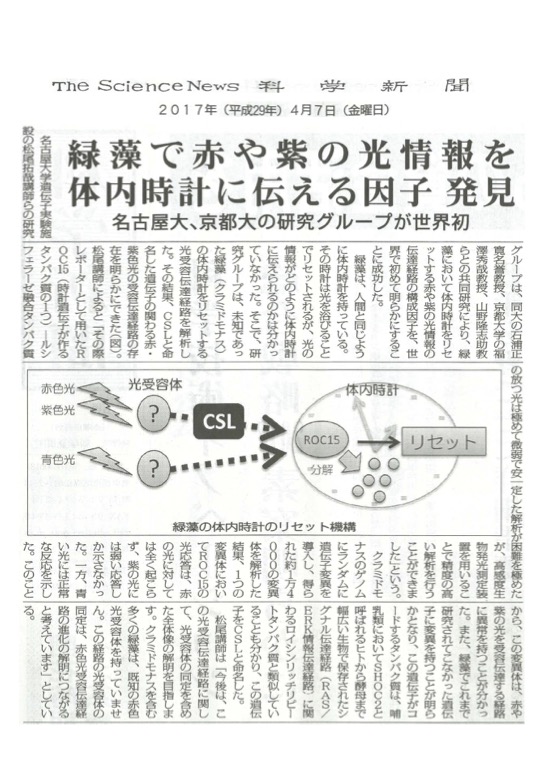
[1] (Collaboration) Kinoshita A, Niwa Y, Onai K, Yamano T, Fukuzawa H, Ishiura M, Matsuo T*
CSL encodes a leucine-rich-repeat protein implicated in red/violet light signaling to the circadian clock in Chlamydomonas.
PLOS Genet. 2017 Mar 23;13(3):e1006645.
2016
[4] Wang L, Yamano T, Takane T, Niikawa Y, Toyokawa C, Ozawa S, Tokutsu R, Takahashi Y, Minagawa J, Kanesaki Y, Yoshikawa H, Fukuzawa H*Chloroplast-mediated regulation of CO2-concentrating mechanism by Ca2+-binding protein CAS in the green alga Chlamydomonas reinhardtii.
Proc Natl Acad Sci USA. 2016 Nov 1;113(44):12586-12591.
We showed that the algal calcium-binding protein CAS controls the CO2-concentrating mechanism by regulating bicarbonate transporter expression.
[3] (Review in Japanese) Yamano T, Fukuzawa H
Bicarbonate transport supports photosynthesis in microalgae: discovery of bicarbonate transporters in the plasma membrane and chloroplast envelope
Kagaku to Seibutsu 54(7):459-460 (2016)
[2] (Method paper) Yamano T, Fukuzawa H*
Indirect Immunofluorescence Assay in Chlamydomonas reinhardtii.
Bio-protocol: 6(13):e1864 (2016)
A detailed protocol for indirect immunofluorescence staining to examine where proteins are located inside cells.
[1] (Patent) Fukuzawa H, Yamano T, Ifuku K, Hayakawa Y
Method of transferring gene into algal cell involving utilizing multiple square-wave pulses in three steps. US Patent No. 9255276
A US patent was granted for our transformation technology, including the method reported in J Biosci Bioeng in 2013. The patent certificate is available here.
2015
[3] Yamano T, Sato E, Iguchi H, Fukuda Y, Fukuzawa H*Characterization of Cooperative Bicarbonate Uptake into Chloroplast Stroma in the Green Alga Chlamydomonas reinhardtii.
Proc. Natl. Acad. Sci. USA. 2015 Jun 9;112(23):7315-20.
We identified the two-step bicarbonate transport pathway across the plasma membrane and chloroplast envelope, the HLA3/LCIA system, that supports the CCM.
[2] Kajikawa M, Sawaragi Y, Shinkawa H, Yamano T, Ando A, Kato M, Hirono M, Sato N, Fukuzawa H*
Algal Dual-specificity Tyrosine-phosphorylation-regulated Kinase TAR1 Regulates Accumulation of Triacylglycerol in Nitrogen- or Sulfur-deficiency.
Plant Physiol. 2015 Jun;168(2):752-64.
By analyzing the Chlamydomonas mutant tar1-1, which shows abnormal TAG accumulation, we identified TAR1 as the protein kinase gene involved in this regulation.
[1] (Patent) Fukuzawa H, Yamano T, Ifuku K, Hayakawa Y
Invention: "Method of transferring genes into algal cells using multiple square-wave pulses in three steps." Japanese Patent No. 5721191
A Japanese patent was granted for our transformation technology, including the method reported in J Biosci Bioeng in 2013. The patent certificate is available here.
2014
[2] Wang L, Yamano T, Kajikawa M, Hirono M, Fukuzawa H*Isolation and characterization of novel high-CO2 requiring mutants of Chlamydomonas reinhardtii.
Photosynth Res. 2014 Sep;121(2-3):175-84.
We isolated and characterized three high-CO2-requiring mutants from about 20,000 transformants generated by DNA tagging.
[1] Yamano T, Asada A, Sato E, Fukuzawa H*
Isolation and characterization of mutants defective in the localization of LCIB, an essential factor for the carbon-concentrating mechanism in Chlamydomonas reinhardtii.
Photosynth Res 2014 Sep;121(2-3):193-200. doi: 10.1007/s11120-013-9963-6.
We isolated and characterized 12 mutants with aberrant LCIB localization (abl mutants) from about 13,000 transformants generated by DNA tagging.
2013
[1] Yamano T, Iguchi H, Fukuzawa H*Rapid transformation of Chlamydomonas reinhardtii without cell-wall removal.
J Biosci Bioeng. 2013 Jun;115(6):691-4.
We developed a rapid and highly efficient Chlamydomonas transformation method using three-step, multiple square-wave pulse electroporation.
For papers published in 2012 or earlier, please visit Yamano's researchmap page.